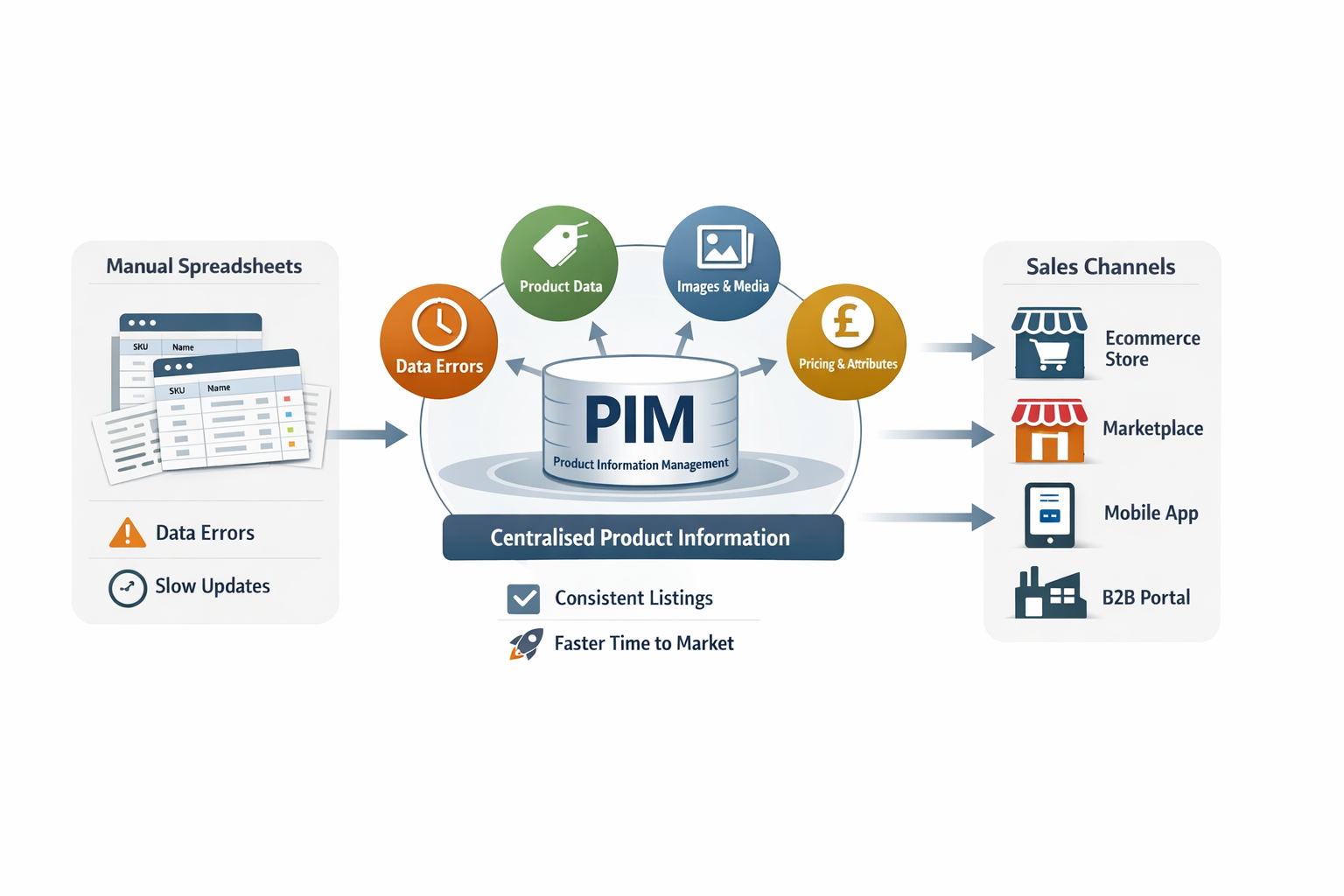
Why UK Manufacturers Are Ditching Excel for Product Catalogue Software
It’s Monday morning.
A dealer calls asking for your latest price list. You open Excel, quickly search your folders and find three different versions of the product catalogue:
ProductList_Final.xlsx
ProductList_Final_v2.xlsx
ProductList_Final_USE_THIS.xlsx
You’re not entirely sure which one is correct.
You check with the sales team. Someone updated prices last week. Marketing changed product descriptions. Operations added five new SKUs.
Twenty minutes later, you’re still trying to figure out which spreadsheet is the latest version.
Meanwhile the dealer is waiting.
If this scenario feels familiar, you’re not alone. Many UK manufacturers and wholesalers start with Excel to manage their product catalogue. It’s quick, flexible and everyone knows how to use it.
But as product ranges grow and sales channels multiply, spreadsheets start creating more problems than they solve.
That’s why many businesses are moving towards product catalogue software designed specifically for managing product data.
The Real Cost of Spreadsheet Chaos
Spreadsheets rarely fail overnight. They simply become more complicated over time.
At first, Excel works perfectly well. You might have:
50 products
one spreadsheet
one person managing it
But over time, things change.
You add more products. Variants appear. Dealers request custom price lists. Sales teams need product sheets. Marketing wants better descriptions and images.
Suddenly the catalogue isn’t simple anymore.
Version Control Becomes Impossible
One of the biggest issues with spreadsheets is version control.
Different teams download copies and make edits. Files get emailed around. Someone saves a local version on their laptop.
Before long you have multiple versions of the same catalogue floating around.
This leads to questions like:
“Did anyone update the distributor pricing?”
“Are these the latest SKUs?”
“Why does the website show a different description?”
These small uncertainties add up quickly.
Product Data Errors Increase
Manual data entry inevitably creates mistakes.
Common spreadsheet errors include:
incorrect SKUs
outdated pricing
missing product attributes
inconsistent naming conventions
For wholesalers and manufacturers, these errors can cause real operational problems.
Imagine a retailer listing a product online using outdated specifications. Or a dealer quoting a customer with the wrong price.
These errors damage trust and create unnecessary back-and-forth with partners.
Time Gets Wasted on Admin Work
Perhaps the biggest hidden cost is time.
Teams end up spending hours doing tasks such as:
copying product data between sheets
updating dealer catalogues
correcting formatting errors
searching for missing information
This is time that could be spent on sales, product development or marketing instead.
Missed Sales Opportunities
When product information is messy, it becomes harder to launch new products quickly.
Sales teams often delay sending catalogues because the information isn’t ready.
Retailers wait longer for product data.
And sometimes opportunities simply disappear because the catalogue wasn’t prepared in time.
Spreadsheet chaos doesn’t just waste time — it can slow down revenue growth.
What Changes When You Move to Product Catalogue Software
Moving from spreadsheets to dedicated product catalogue software in the UK fundamentally changes how product information is managed.
Instead of juggling multiple files, everything lives in a single structured system.
Here are some of the biggest improvements businesses notice.
1. One Single Source of Truth
Product catalogue software centralises product data.
Instead of multiple spreadsheets, you have one definitive catalogue.
Everyone works from the same information:
sales teams
marketing
operations
dealers
This immediately removes confusion about which version is correct.
2. Product Variants Become Easy to Manage
Many manufacturers deal with product variants such as:
sizes
colours
materials
packaging options
In Excel, variants often turn into messy rows and duplicated data.
Catalogue software allows you to structure products properly.
For example:
Product: Stainless Steel Frying Pan
Variants:
20cm
24cm
28cm
Each variant has its own SKU while sharing core product information.
This structure keeps your catalogue organised as it grows.
3. Faster Product Launches
When your catalogue is structured, launching new products becomes much faster.
Instead of building a spreadsheet from scratch, you simply add a new product and fill in the required fields.
Images, attributes and specifications can be reused easily.
For manufacturers releasing seasonal products or collections, this makes a huge difference.
4. Dealer and Distributor Catalogues Are Easier to Generate
Wholesalers often work with many dealers or distributors.
Each one may require slightly different catalogue formats.
With spreadsheets, generating these variations can take hours.
Product catalogue software allows you to export clean data quickly for:
dealer catalogues
e-commerce stores
marketplaces
price lists
This dramatically reduces manual admin work.
A Real Example: When Spreadsheets Stop Scaling
Consider a UK kitchenware wholesaler managing around 800 SKUs.
Their products include:
knives
cookware
utensils
accessories
They sell through:
30 independent kitchen retailers
an e-commerce store
several online marketplaces
Originally, their entire catalogue lived in Excel.
Over time the spreadsheet grew to thousands of rows.
Problems began appearing:
variant rows became confusing
images were stored in separate folders
pricing updates required editing multiple sheets
dealers regularly received outdated catalogues
The operations team spent several hours each week fixing catalogue issues.
After moving to dedicated catalogue software, they centralised product information and organised SKUs properly.
As a result:
dealers received accurate catalogues
product launches became faster
internal admin time dropped significantly
The biggest benefit wasn’t just organisation — it was operational clarity.
What to Look for in Product Catalogue Software
Not all tools are designed with wholesalers and manufacturers in mind.
When evaluating product catalogue software in the UK, focus on practical capabilities rather than flashy features.
Here are some essentials to consider.
Easy Excel Import
Most businesses already have their catalogue in spreadsheets.
Good software should allow you to import Excel data quickly so you don’t have to rebuild everything from scratch.
Flexible Product Attributes
Manufacturers often need to store technical information such as:
dimensions
materials
certifications
packaging details
The software should allow you to create custom attributes that match your products.
Rigid systems can limit how you organise your catalogue.
Variant Management
If your products come in multiple sizes or colours, variant management is essential.
Look for tools that support:
parent products
variant SKUs
shared product data
This structure keeps catalogues clean and scalable.
Media Management
Images and product documents should be linked directly to products.
This avoids problems such as outdated images appearing in catalogues or websites.
Export and Channel Integration
Your catalogue shouldn’t stay trapped in one system.
The right software should make it easy to send product data to:
e-commerce platforms
marketplaces
dealer catalogues
internal systems
This keeps product information consistent everywhere.
The Shift Happening Across UK Manufacturing
Across the UK, manufacturers and wholesalers are gradually moving away from spreadsheet-driven catalogues.
The reason is simple.
Product ranges are growing. Sales channels are multiplying. Expectations from retailers and distributors are increasing.
Managing all of this through spreadsheets becomes increasingly fragile.
Dedicated catalogue software provides the structure needed to support modern product operations.
It doesn’t replace spreadsheets entirely — Excel still plays a role in exports, analysis and reporting.
But it removes spreadsheets from the one place they struggle most: being the central product database.
A Simpler Way to Manage Your Catalogue
If your product catalogue still lives in multiple spreadsheets, you’re not alone.
But there is a better way to organise product information without the chaos of version control, duplicated files and constant manual updates.
If you’re exploring product catalogue software in the UK, tools like productrue are designed specifically for manufacturers and wholesalers who want to move beyond spreadsheet management.
You can import your existing catalogue, organise products properly and start managing your product data from one central platform.
Learn more at productrue.com.