What Is Omnichannel Commerce?
Modern customers do not shop on just one channel.
They browse on marketplaces, compare on websites, interact on social platforms and purchase through ecommerce stores or B2B portals. For businesses, this creates a fundamental challenge:
How do you sell the same product across multiple channels without losing control?
This is where omnichannel commerce becomes essential.
What Does Omnichannel Commerce Really Mean?
Omnichannel commerce is often confused with multi-channel selling, but the difference is critical.
Multi-channel means selling on multiple platforms
Omnichannel means managing those platforms as one connected ecosystem
In an omnichannel approach:
Product data is consistent everywhere
Updates are synchronised
Customer experience feels seamless
The product is the same — only the context changes.
Why “One Product, Many Channels” Is So Hard in Practice
Selling across channels sounds straightforward, but operationally it is complex.
Common challenges include:
Different attribute requirements per channel
Channel-specific naming and categorisation
Inconsistent pricing and availability
Manual duplication of product data
Slow updates and frequent errors
Without a clear strategy, each new channel increases complexity exponentially.
The Role of Product Data in Omnichannel Success
At the centre of omnichannel commerce sits product data.
Every channel depends on:
Accurate attributes
Correct pricing
High-quality images
Structured descriptions
Channel-ready formats
If product data is fragmented, omnichannel operations break down quickly.
Why Platform-Centric Management Fails
Many businesses attempt omnichannel selling by managing products separately in:
Ecommerce platforms
Marketplaces
ERP systems
Spreadsheets
This leads to:
Conflicting data sources
Repetitive manual work
Inconsistent customer experience
Increased risk of errors
Platforms are channels — they are not designed to be the master source of product truth.
Centralising Product Data for Omnichannel Commerce
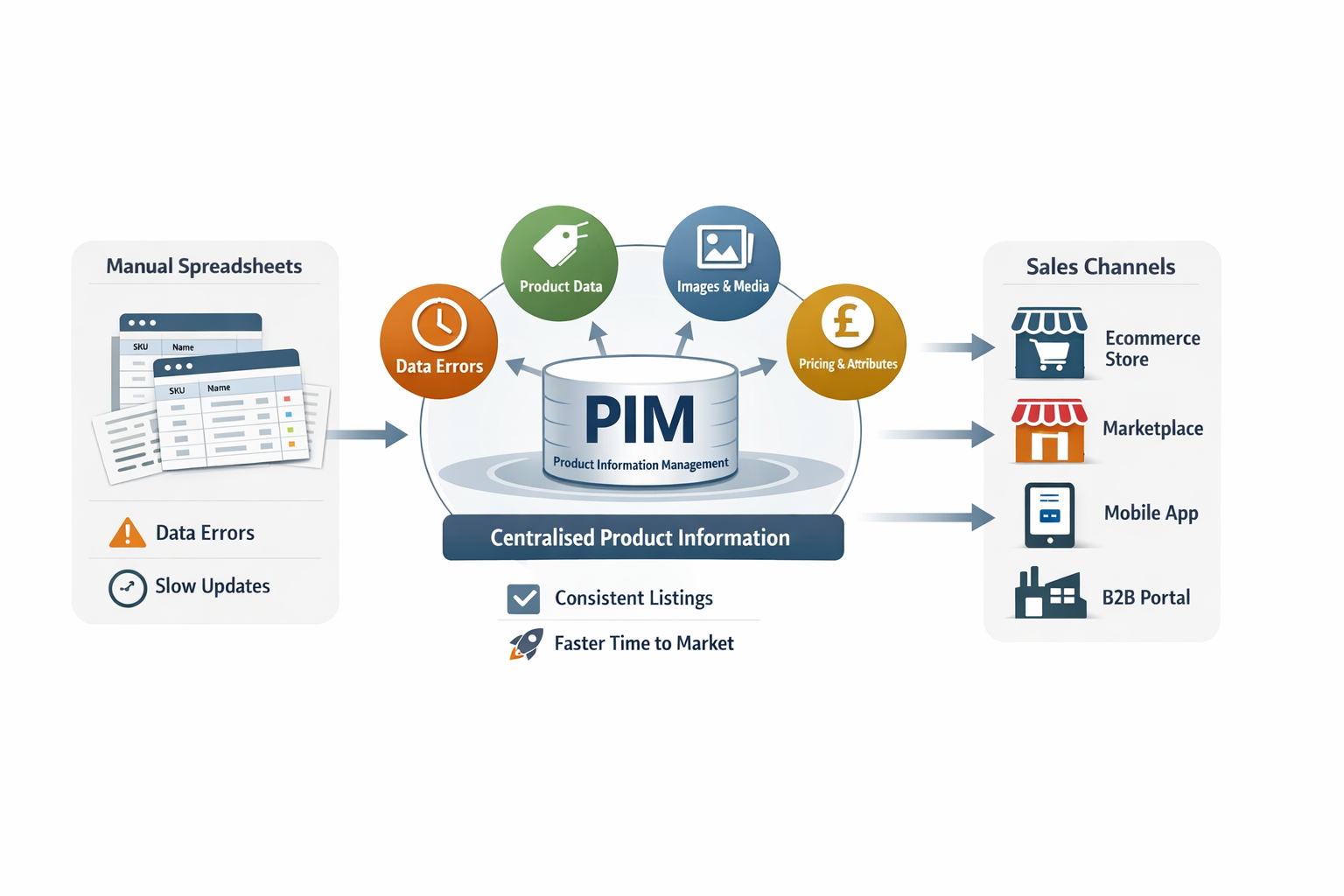
A scalable omnichannel strategy starts with centralised product information.
By managing product data in one place, businesses can:
Maintain a single source of truth
Adapt product information per channel
Publish updates simultaneously
Scale without duplicating effort
This separation between product data and sales channels is key.
How PIM Enables Omnichannel Selling
A Product Information Management (PIM) system provides the foundation for omnichannel commerce.
With PIM, businesses can:
Manage one product model centrally
Define channel-specific fields without duplication
Control data quality and validation
Distribute products to multiple channels consistently
This makes “one product, many channels” operationally realistic.
Omnichannel in B2B vs B2C
Omnichannel complexity increases further in B2B environments.
Additional factors include:
Dealer-specific pricing
Restricted product visibility
Customer-specific catalogues
Multiple ordering channels
Without structured product data, these requirements become extremely difficult to manage.
Building an Omnichannel Strategy Step by Step
A practical omnichannel approach typically involves:
Defining a clean, scalable product structure
Centralising product information
Separating product data from channels
Applying channel-specific rules
Automating synchronisation and updates
Each step reduces manual work and increases consistency.
Final Thoughts
Omnichannel commerce is not about being everywhere — it is about being consistent everywhere.
Businesses that treat product data as a strategic asset, rather than a by-product of platforms, are the ones that scale successfully across channels.
In the next articles, we will explore:
Channel-specific field mapping
Marketplace product requirements
PIM-driven omnichannel architectures