Why It Has Become Essential for Ecommerce Businesses
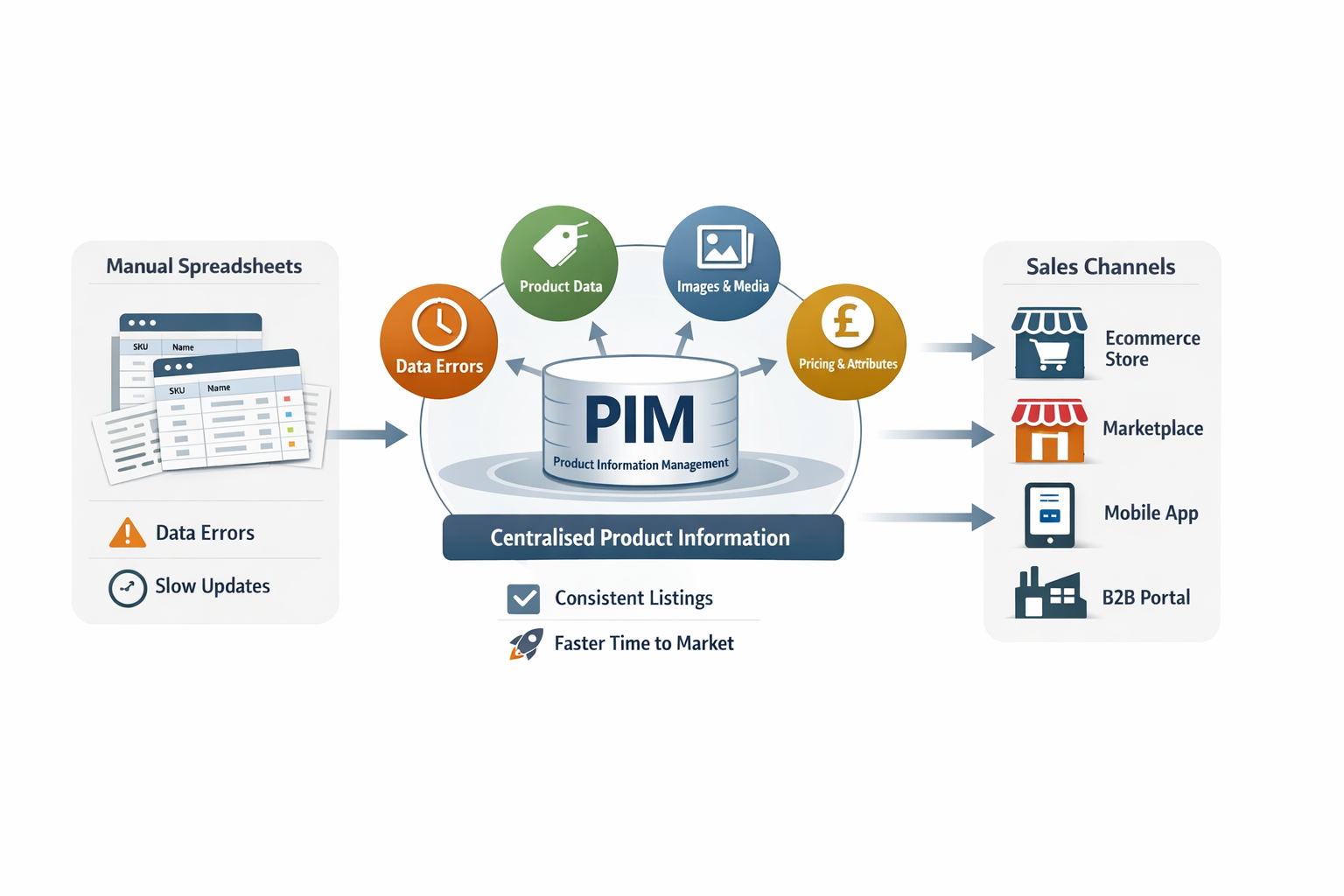
As ecommerce businesses scale, product data quickly becomes one of the biggest operational bottlenecks. What starts as a simple spreadsheet soon turns into a complex web of SKUs, variants, prices, descriptions, images and channel-specific requirements.
This is where Product Information Management (PIM) becomes essential.
What Is Product Information Management (PIM)?
Product Information Management (PIM) is a system that centralises, structures and manages all product-related information in one place, and distributes it consistently across every sales and marketing channel.
A PIM system acts as the single source of truth for product data, including:
Product names and descriptions
SKUs, variants and attributes
Images, documents and media assets
Pricing and catalogue data
Localised content (languages, regions, currencies)
Channel-specific fields and formats
Instead of maintaining product information separately for each platform, PIM allows businesses to manage everything centrally and publish it wherever needed.
Why Managing Product Data Becomes a Problem Without PIM
Many ecommerce teams rely on spreadsheets, ERP systems or individual platform dashboards. This approach works only up to a point.
Common challenges include:
Inconsistent product data across channels
Manual updates that do not scale
Errors in pricing, attributes or availability
Slow product launches and catalogue updates
Difficult collaboration between teams
As the number of products, variants and channels grows, these issues compound and directly affect revenue, customer trust and operational efficiency.
How PIM Solves These Problems
A PIM system introduces structure, automation and governance to product data management.
1. A Single Source of Truth
All product information is stored and maintained in one central system, eliminating duplication and conflicting data.
2. Faster Time to Market
Products can be enriched once and published to multiple channels simultaneously, reducing launch times dramatically.
3. Consistent Omnichannel Experience
Customers see accurate, complete and consistent product information across marketplaces, ecommerce platforms and B2B catalogues.
4. Improved Data Quality
Validation rules, mandatory attributes and structured schemas significantly reduce errors and missing information.
5. Scalable Catalogue Management
PIM systems are designed to handle large catalogues with thousands of products and complex variant structures.
PIM vs ERP: Understanding the Difference
A common misconception is that ERP systems can replace PIM.
While ERP systems are excellent for transactions, inventory and finance, they are not designed to manage rich, marketing-focused product information.
ERP
Operational data
Stock & orders
Internal processes
Limited flexibility
PIM
Product content
Attributes & descriptions
Customer-facing data
Highly flexible data model
In practice, PIM and ERP work best together, each focusing on what they do best.
Who Needs a PIM System?
PIM is no longer reserved for large enterprises. It is increasingly essential for:
Ecommerce businesses with growing product ranges
B2B wholesalers and distributors
Brands selling across multiple marketplaces
Companies operating in multiple languages or regions
Businesses struggling with spreadsheet-based workflows
If product updates feel slow, error-prone or chaotic, PIM is usually the missing layer.
Why PIM Is Now Essential, Not Optional
Modern ecommerce is data-driven and omnichannel by default. Customers expect accurate, detailed and consistent product information wherever they interact with a brand.
Without a PIM system:
Product data becomes fragmented
Operational costs increase
Scaling becomes risky and inefficient
With PIM:
Product data becomes a competitive advantage
Teams work faster and more confidently
Growth becomes predictable and sustainable
Final Thoughts
Product Information Management is no longer a “nice to have”. For ecommerce and B2B businesses aiming to scale, it is a foundational system that enables control, consistency and growth.
In the next articles, we will explore:
Moving from Excel to PIM
Product data quality and conversion rates
Technical product models such as EAV vs flat structures
These topics build directly on the concepts introduced here.