Growth is the goal of almost every ecommerce business.
More products, more channels, more markets and more customers.
But as ecommerce operations scale, one critical question often goes unasked:
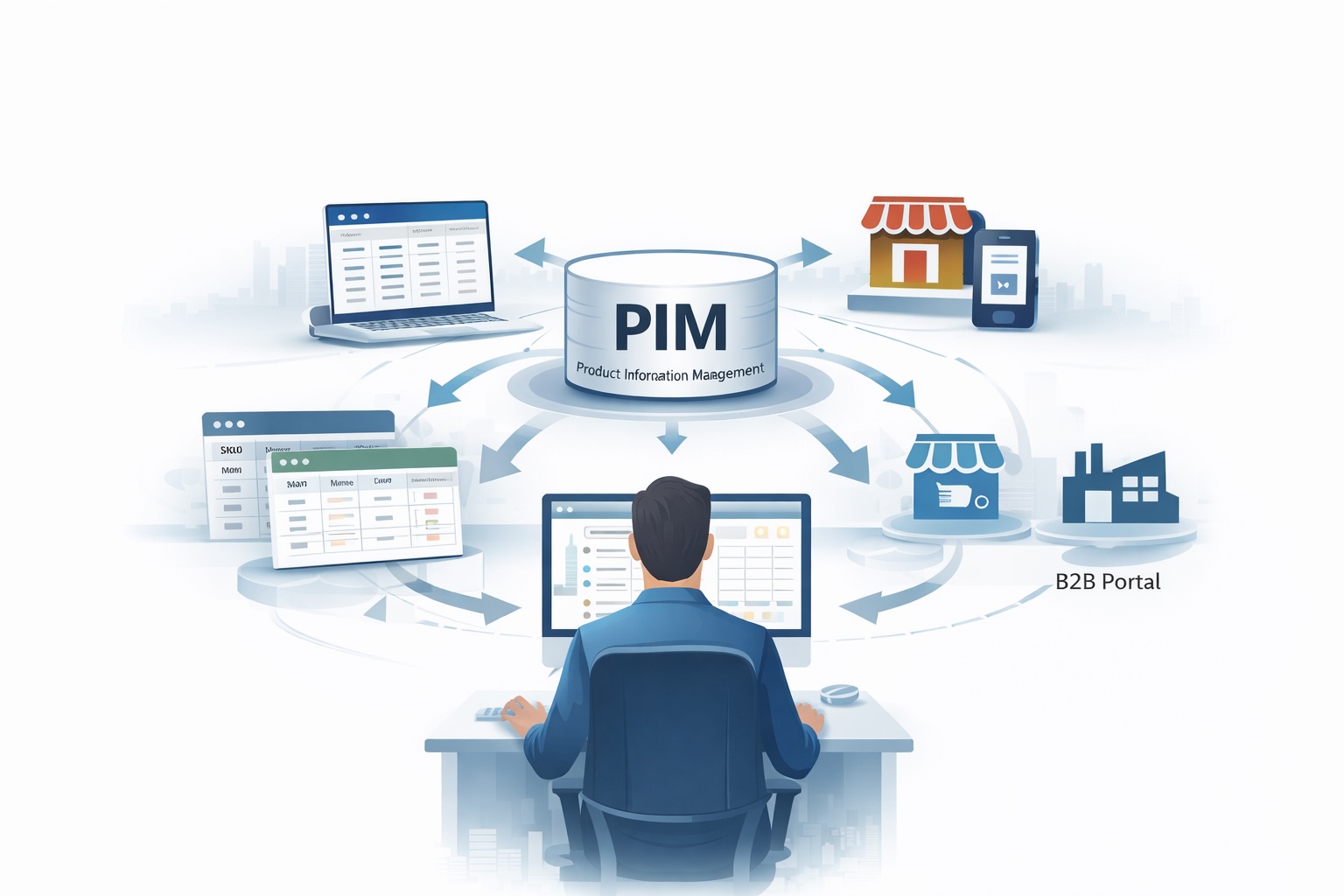
Can ecommerce really scale without Product Information Management (PIM)?
What Does “Scalable Ecommerce” Actually Mean?
Scalability is not just about increasing revenue.
A scalable ecommerce operation can:
Add new products without operational friction
Launch on new channels quickly
Enter new markets with minimal rework
Maintain consistent customer experience
Control costs as complexity increases
True scalability means growth without proportional chaos.
The Early Stage: When Ecommerce Appears Scalable Without PIM
At the beginning, many businesses manage product data using:
Spreadsheets
Ecommerce platform back offices
ERP systems
Manual processes
At low volume, this can work. Product ranges are limited, teams are small and updates are manageable.
This creates a false sense of scalability.
The Breaking Point: When Growth Exposes Structural Weaknesses
As complexity increases, cracks begin to show.
Typical symptoms include:
Product updates taking days instead of minutes
Inconsistent information across channels
Increasing error rates and returns
Slower onboarding of new products
Growing dependency on manual work
At this stage, growth no longer feels linear — it feels fragile.
Why Product Data Becomes the Bottleneck
In modern ecommerce, product data sits at the centre of everything.
Every channel, campaign and customer interaction depends on:
Accurate attributes
Complete descriptions
Correct pricing
Consistent imagery
Structured categorisation
Without a central system, each new product and channel multiplies operational complexity.
Why PIM Is a Scalability Enabler, Not a “Nice to Have”
A Product Information Management (PIM) system removes product data from the critical path of manual work.
PIM enables businesses to:
Manage product data centrally
Enforce structure and validation
Scale catalogues without duplicating effort
Optimise product information per channel
Decouple product growth from operational cost
This makes growth predictable instead of risky.
Scaling Without PIM: The Hidden Costs
Some businesses delay PIM adoption to “save time” or “avoid complexity”.
In practice, this often leads to:
Higher operational overhead
Increased reliance on key individuals
Slower market expansion
Data-driven decisions becoming unreliable
Missed growth opportunities
The cost of not using PIM increases with every additional SKU and channel.
B2B and Omnichannel: Where Scalability Fails First
Scalability challenges are amplified in:
B2B ecommerce with dealer-specific pricing
Multi-language and multi-region catalogues
Marketplace-heavy sales strategies
Large or highly variant product ranges
In these scenarios, manual product data management becomes unworkable very quickly.
The Reality: Can Ecommerce Scale Without PIM?
Technically, yes — up to a point.
Practically, no.
Without PIM:
Growth becomes slower
Errors increase
Teams burn time on data maintenance
Customer experience degrades
With PIM:
Product operations scale with confidence
Teams focus on growth, not cleanup
Product data becomes a strategic asset
Final Thoughts
Scalable ecommerce is not just about technology stacks, marketing budgets or logistics networks.
It is fundamentally about control over product information.
Businesses that want sustainable, multi-channel growth eventually reach the same conclusion:
Product Information Management is not optional — it is foundational.
In the next articles, we will explore:
Technical product models and scalability
Large catalogue performance strategies
How PIM supports omnichannel growth