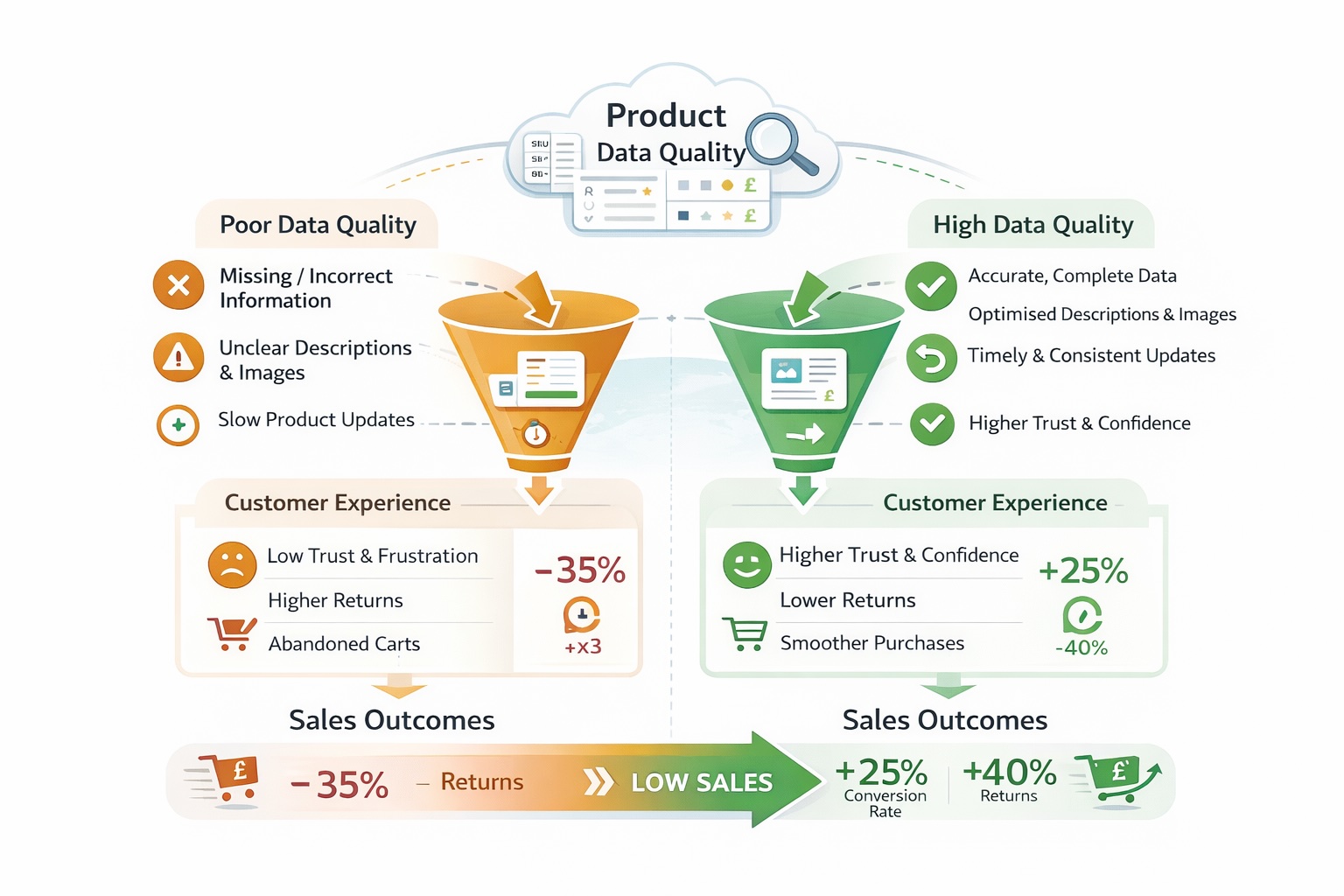
In ecommerce, customers do not touch, test or experience products physically.
Their buying decision is based almost entirely on product data.
This makes product data quality one of the most underestimated — yet most influential — drivers of online sales.
What Do We Mean by Product Data Quality?
High-quality product data is:
Accurate
Complete
Consistent
Up to date
Structured for multiple channels
This includes not only product titles and descriptions, but also attributes, specifications, images, pricing and categorisation.
Poor-quality product data, on the other hand, creates friction at every stage of the customer journey.
How Poor Product Data Reduces Conversion Rates
Even small data issues can have a measurable impact on sales.
Common problems include:
Missing or unclear product descriptions
Inconsistent attribute values (size, material, compatibility)
Low-quality or insufficient images
Incorrect pricing or availability
Different information across channels
When customers hesitate or feel uncertain, they abandon the purchase.
The Link Between Product Data Quality and Customer Trust
Trust is built through clarity and consistency.
When product information:
Matches across website, marketplace and ads
Clearly answers common questions
Feels reliable and professional
customers are far more likely to complete a purchase.
Inconsistent or incomplete data signals operational weakness and reduces confidence in the brand.
Product Data Quality and Returns: The Hidden Cost
Returns are often treated as a logistics problem, but in many cases they are a data problem.
Inaccurate product information leads to:
Wrong expectations
Incorrect size or specification choices
Mismatched use cases
Improving product data quality reduces returns by aligning customer expectations with reality.
Why Manual Product Data Management Fails at Scale
Spreadsheets and platform-specific dashboards struggle to maintain data quality as complexity increases.
Typical issues include:
Manual copy-paste errors
No validation rules
No single source of truth
Difficult collaboration between teams
Slow updates across channels
As catalogues grow, maintaining consistent data manually becomes unsustainable.
How PIM Improves Product Data Quality
A Product Information Management (PIM) system introduces control and structure.
Key benefits include:
Centralised product information
Mandatory attributes and validation rules
Consistent data models across products
Controlled updates and permissions
Channel-specific optimisation without duplication
By managing product data centrally, businesses improve accuracy while reducing effort.
Structured Product Data Drives Better Channel Performance
High-quality product data does not only help customers — it also improves performance across channels.
Well-structured data enables:
Better marketplace visibility
Improved feed quality for advertising platforms
More effective search and filtering
Faster product onboarding
Channels reward clean, consistent data with better placement and performance.
Product Data Quality as a Competitive Advantage
Many ecommerce businesses compete on price and marketing.
Fewer compete on data quality.
Yet structured, reliable product information:
Improves conversion rates
Reduces operational costs
Builds long-term trust
Enables faster scaling
Over time, this becomes a sustainable competitive advantage.
Final Thoughts
Product data quality directly influences how customers perceive, trust and purchase products online.
As ecommerce becomes more complex and omnichannel by default, managing product data professionally is no longer optional. Businesses that invest in structured, centralised product information are better positioned to grow efficiently and predictably.
In the next articles, we will explore:
How to measure product data quality
Technical product models and validation strategies
The role of PIM in large catalogues