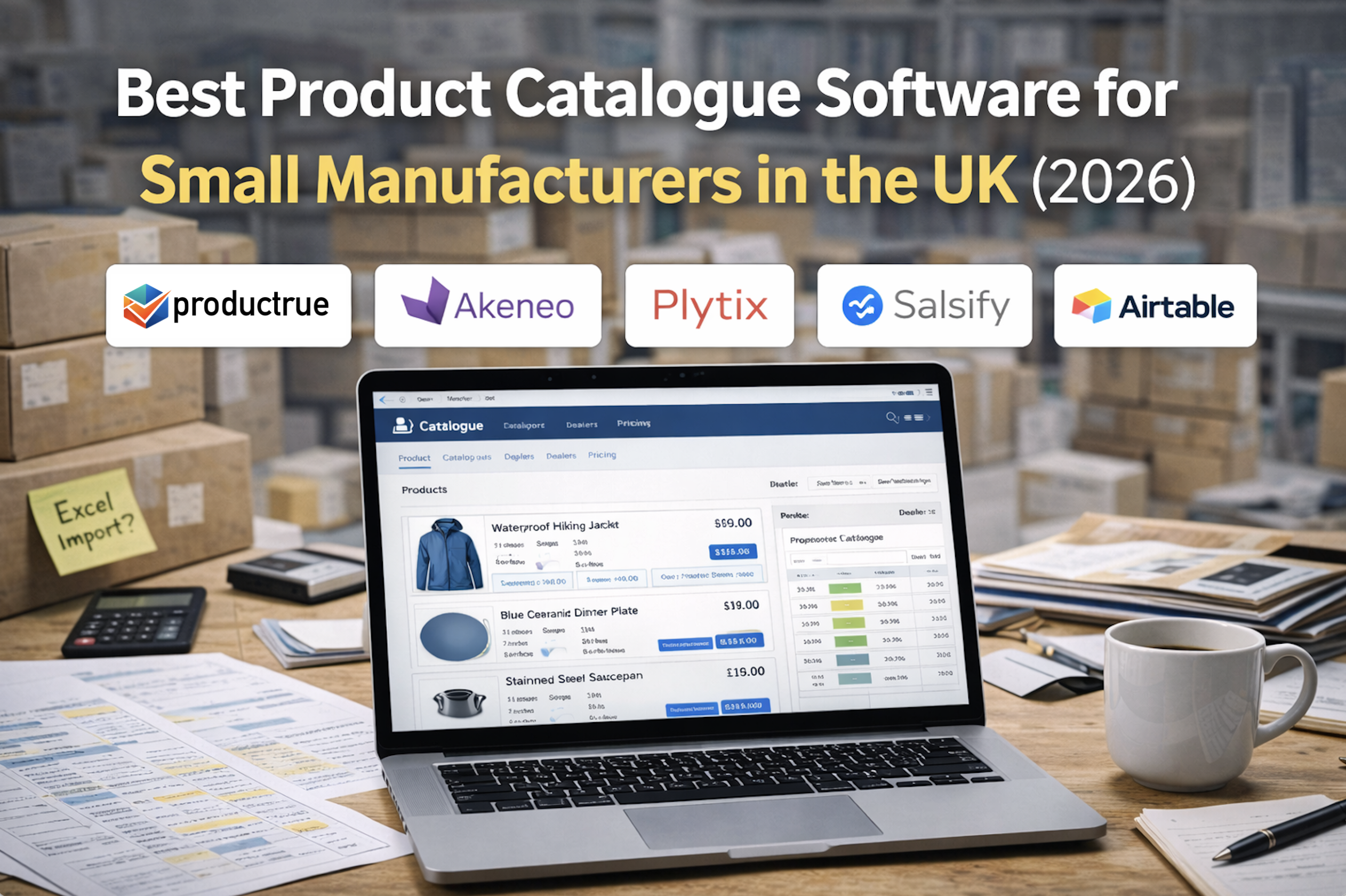
If you’re a UK manufacturer or wholesaler, your product catalogue sits at the centre of your operations.
It feeds your sales team, your dealers, your website, your price lists and often your internal systems. Yet in many businesses, catalogue management still relies on spreadsheets, shared drives and manual updates.
At some point, this stops working.
You start looking for wholesale catalogue software in the UK — but quickly realise there are dozens of options, from simple tools to complex enterprise platforms.
This guide cuts through the noise. No jargon, no sales pitch — just a practical overview of what matters when choosing the right system for your business.
What Wholesale Catalogue Software Actually Does (and What It Doesn’t)
At its core, wholesale catalogue software is designed to centralise and organise your product data so it can be used consistently across your business and shared easily with dealers.
A good system allows you to:
Store all product information in one place
Manage SKUs, variants and attributes
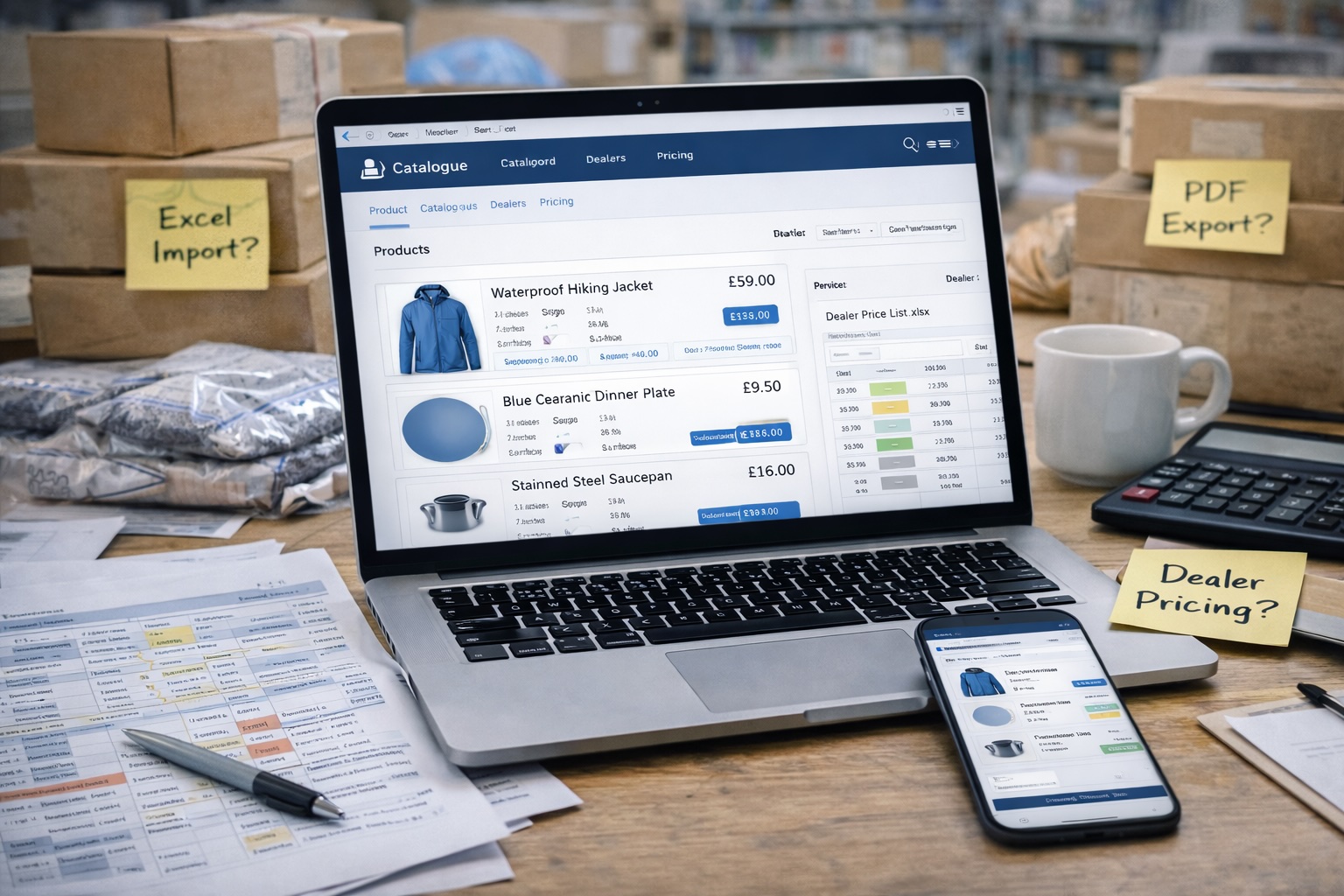
Maintain dealer-specific pricing
Share catalogues with partners
Update product data once and use it everywhere
In simple terms, it replaces the chaos of spreadsheets with structure.
What It Doesn’t Do (Despite Some Claims)
It’s equally important to understand what catalogue software is not.
It is not:
A full ERP system
A complex accounting platform
A replacement for every internal system
A “magic” tool that fixes poor data instantly
Some vendors bundle catalogue software into large enterprise systems. For most UK SMEs, this introduces unnecessary complexity.
The goal isn’t to overhaul your entire tech stack.
The goal is to take control of your product data without overcomplicating your operations.
The 6 Key Features to Look For
When evaluating wholesale catalogue software, focus on practical capabilities that solve real problems in your day-to-day operations.
Product & Variant Management
Your catalogue needs to handle more than just product names and prices.
Most wholesale businesses deal with:
multiple sizes
colours
materials
configurations
The system should allow you to:
define parent products
manage variants cleanly
avoid duplicating product data
If your current spreadsheet has rows repeating the same product with minor variations, this feature alone will make a significant difference.
Dealer/Customer-Specific Pricing
Wholesale pricing is rarely one-size-fits-all.
You may have:
standard trade pricing
distributor pricing
region-based pricing
negotiated customer rates
Good catalogue software should allow you to:
assign pricing per dealer or group
manage discounts centrally
avoid maintaining multiple price lists
This removes the need for sending different spreadsheets to different customers — and reduces pricing errors.
Branded Catalogue Export (PDF or Online Portal)
Your catalogue isn’t just internal — it’s how dealers interact with your products.
The software should allow you to:
generate clean, branded PDF catalogues
share online catalogues with dealers
control what each customer sees
An online portal is particularly valuable.
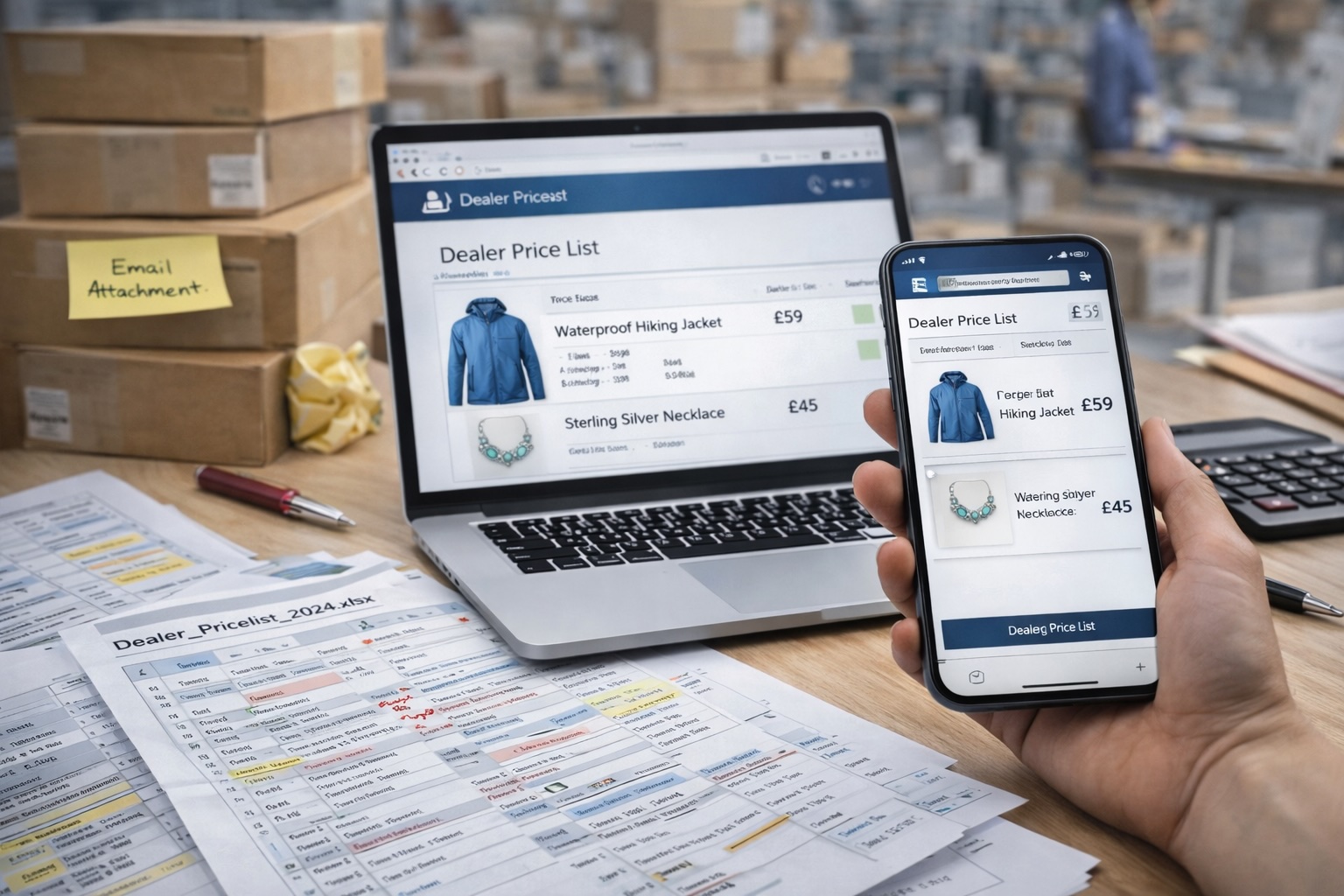
Instead of emailing price lists, dealers can access a live catalogue where information is always up to date.
This alone can eliminate a large amount of admin work.
Import from Excel
Let’s be realistic.
Most businesses already have their product catalogue in Excel.
Any software that requires you to manually rebuild your catalogue from scratch is a red flag.
Look for tools that:
support bulk Excel import
map your existing columns easily
allow iterative updates
A smooth import process reduces friction and speeds up adoption significantly.
Integration with Orders and Inventory
Catalogue data doesn’t exist in isolation.
It connects directly to:
orders
stock levels
fulfilment processes
While catalogue software doesn’t need to replace your entire system, it should integrate with or support:
order creation workflows
inventory visibility
export or API connections
For UK SMEs, simple integrations are often more valuable than complex enterprise setups.
GDPR Compliance and UK Data Hosting
For UK businesses, data compliance is non-negotiable.
When evaluating software, check:
where data is hosted
whether GDPR requirements are met
how customer and dealer data is handled
You don’t need deep technical knowledge, but you should feel confident that:
your data is secure
your customers’ data is handled properly
the vendor understands UK regulatory expectations
This is especially important if your catalogue includes customer-specific pricing or dealer information.
Questions to Ask Vendors Before Buying
Before committing to any wholesale catalogue software, it’s worth asking a few direct questions.
These will quickly reveal whether the tool fits your business.
1. How long does it take to get set up?
If the answer involves weeks of onboarding, consultants or custom development, it may not be suitable for an SME.
2. Can I import my existing Excel catalogue easily?
Ask for a real demonstration, not just a feature list.
3. How do you handle dealer-specific pricing?
This is a core requirement for wholesalers — not an optional feature.
4. Can my dealers access a live catalogue?
If the answer is “we export PDFs”, you may still face version control issues.
5. What happens when I update a product?
Ideally, updates should:
apply instantly
reflect across all catalogues
require no manual redistribution
6. What does it cost as we grow?
Many tools appear affordable at first but become expensive as you add users or products.
UK SMEs should look for predictable pricing that scales reasonably.
How to Get Started Without a Big Implementation Project
One of the biggest concerns businesses have is implementation.
Many assume that moving away from spreadsheets requires a large, disruptive project.
In reality, it doesn’t have to.
A practical approach looks like this:
Step 1: Start with Your Existing Excel Data
Export your current catalogue and clean up obvious inconsistencies.
You don’t need perfection — just a usable starting point.
Step 2: Import and Structure Your Catalogue
Use software that allows you to import data quickly and organise it into:
products
variants
attributes
This step alone brings immediate clarity.
Step 3: Set Up Dealer Pricing
Define pricing rules and assign them to your existing customers.
This removes the need for multiple spreadsheets.
Step 4: Share a Live Catalogue
Instead of emailing files, share a link to your catalogue.
Encourage dealers to use it as the single source of truth.
Step 5: Gradually Replace Spreadsheet Workflows
You don’t need to change everything overnight.
Start by replacing:
price list sharing
product updates
catalogue exports
Then expand from there.
Choosing the Right Approach for Your Business
The best wholesale catalogue software is not the one with the most features.
It’s the one that:
fits your current operations
solves your immediate problems
is easy for your team to adopt
For many UK manufacturers and wholesalers, this means avoiding overly complex enterprise systems and focusing on tools designed specifically for their needs.
A Practical Next Step
If you’re currently managing your catalogue in spreadsheets, moving to dedicated software can dramatically improve how your business operates.
You’ll spend less time updating files and more time selling, launching products and working with your dealers.
If you’re exploring wholesale catalogue software in the UK, platforms like productrue are designed specifically for manufacturers and wholesalers.
You can start with your existing Excel data, organise your catalogue and begin sharing live product information with your dealers — without a complex implementation project.
Explore how it works at productrue.com.