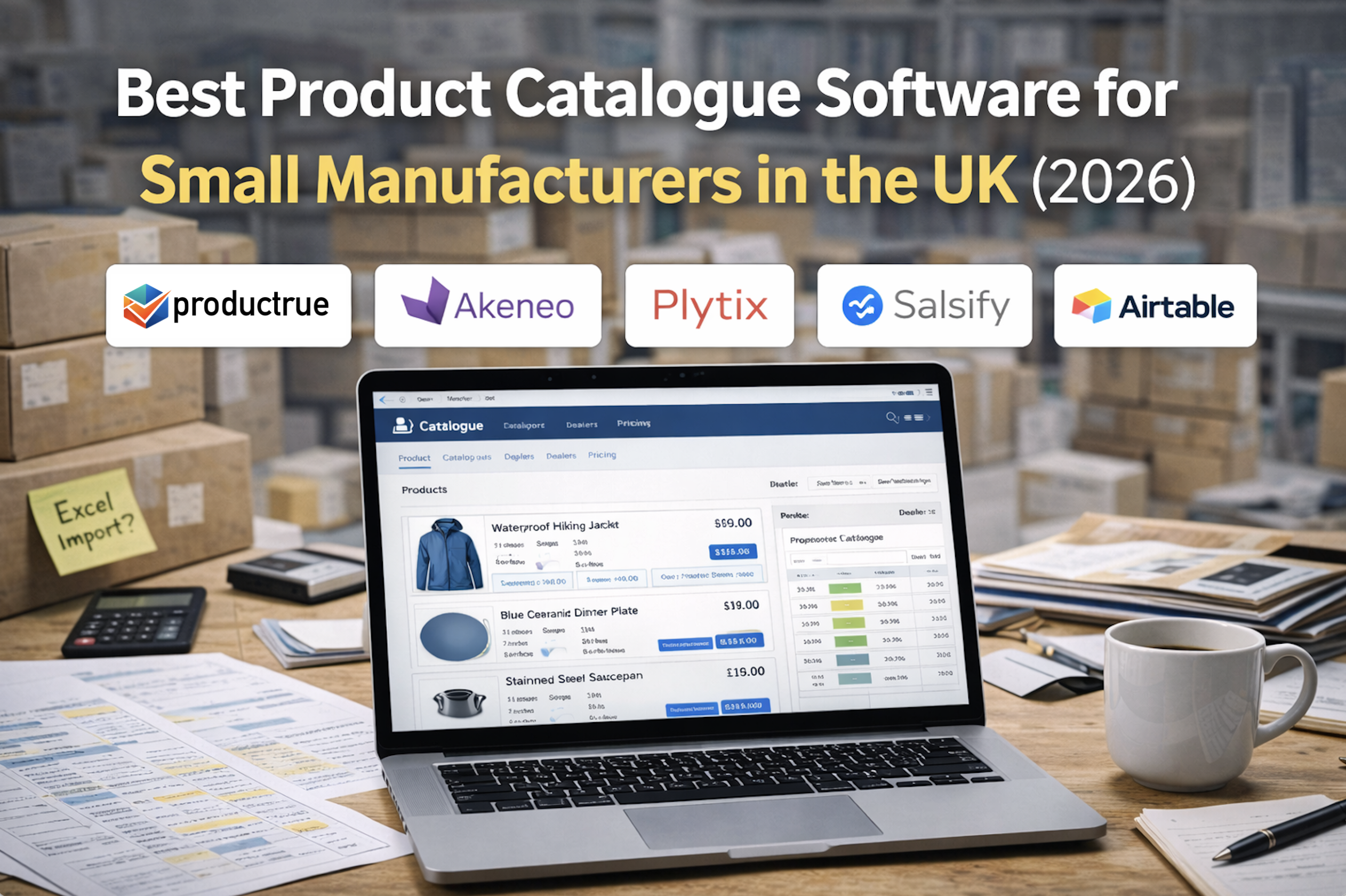
Product Catalogue Management: The Complete Guide for UK Wholesalers and Manufacturers
For wholesalers and manufacturers, product information is the backbone of the business. Every order, listing, distributor agreement, and online sale depends on accurate product data.
Yet many UK companies still manage their product catalogue through scattered spreadsheets, emails, supplier PDFs, and manual updates across multiple systems. As product ranges expand and sales channels multiply, this quickly becomes inefficient and risky.
Product catalogue management is the discipline of organising, maintaining, and distributing product data in a structured and consistent way. Done well, it improves operational efficiency, reduces errors, and helps businesses scale across channels without losing control of their data.
This guide explains what product catalogue management means for UK wholesalers and manufacturers, the challenges many businesses face, and how to build a more reliable product data system.
What Product Catalogue Management Actually Means
Product catalogue management refers to the process of organising and maintaining all the information related to the products a business sells.
This typically includes:
Product names and descriptions
SKUs and barcodes
Product attributes (size, colour, materials, etc.)
Pricing tiers
Images and media
Technical specifications
Stock keeping units and variants
Distributor or dealer pricing
Channel-specific fields (Amazon, Shopify, marketplaces)
For manufacturers and wholesalers, the catalogue is often the single source of truth for product data.
When structured properly, it allows businesses to:
Keep product information consistent across sales channels
Launch new products faster
Provide clean data to retailers and distributors
Reduce manual data entry errors
Improve operational efficiency across teams
Poor catalogue management, on the other hand, leads to duplicated data, outdated listings, and operational bottlenecks.
Why Catalogue Management Matters for UK Manufacturers and Wholesalers
UK manufacturers and distributors operate in a market where products are increasingly sold across multiple channels.
A typical wholesale company might sell through:
Direct B2B sales teams
Dealer networks
Online marketplaces
E-commerce websites
Retail partners
International distributors
Each of these channels often requires slightly different product data.
For example:
Channel
Data Requirements
Dealer catalogue
Trade pricing, bulk packs
Retail listings
Consumer descriptions
Marketplaces
SEO descriptions, images
Internal systems
SKUs, inventory data
Without proper product data management, businesses end up manually copying and modifying product information for each channel.
This creates three major problems:
Data inconsistency
Operational inefficiency
Slow product launches
A structured catalogue system eliminates much of this complexity by allowing product data to be managed centrally.
The Hidden Limitations of Spreadsheet-Based Catalogues
Many UK businesses begin managing their catalogue using spreadsheets. Excel is familiar, flexible, and quick to set up.
However, as product catalogues grow, spreadsheets become increasingly difficult to maintain.
Common challenges include:
1. Version Control Issues
When multiple team members update the catalogue, different versions of the spreadsheet begin circulating.
Teams end up asking questions like:
“Which file is the latest?”
“Did the pricing update get applied?”
“Is this the current product description?”
This slows down operations and creates confusion.
2. Difficulty Managing Product Variants
Variants are common in wholesale and manufacturing catalogues.
For example:
Jewellery available in multiple sizes
Furniture with different finishes
Clothing with colour and size combinations
In spreadsheets, variant structures quickly become messy.
Rows multiply, attributes become inconsistent, and relationships between parent products and variants become unclear.
3. Multi-Channel Distribution Becomes Manual
When product data must be exported to:
a dealer catalogue
a website
a marketplace
a distributor
teams often duplicate data manually.
This introduces errors and consumes significant operational time.
Quick Win Tip
If you are currently using spreadsheets, start by standardising your product attribute names.
For example:
Use one consistent field such as:
Material
Instead of mixing:
Material
Product Material
Base Material
Even this small step can significantly improve data quality.
Common Product Data Mistakes UK Businesses Make
Even well-established manufacturers and wholesalers often struggle with product data management.
Here are some of the most common mistakes.
1. No Clear Product Structure
Many businesses lack a clear hierarchy for their products.
For example:
Parent product
Variants
Attributes
SKUs
Without a structured model, catalogues become difficult to scale.
2. Mixing Commercial and Technical Data
Product information often gets mixed together in a single field or description.
For instance:
A product description might include:
marketing copy
technical specifications
packaging details
This makes it difficult to reuse the data across different channels.
3. Inconsistent Naming Conventions
Product naming inconsistencies create confusion.
Examples:
“Silver Necklace 925”
“925 Sterling Silver Necklace”
“Necklace – Sterling Silver”
These differences make searching, filtering, and exporting product data harder.
4. Lack of Data Ownership
In many businesses, no single team owns the catalogue.
Instead:
marketing edits descriptions
operations manage SKUs
sales update pricing
product teams add specifications
Without governance, catalogue quality deteriorates.
Quick Win Tip
Create a product data ownership model.
For example:
Data Type
Owner
Technical specifications
Product team
Descriptions
Marketing
Pricing
Sales
SKU structure
Operations
This small change prevents many catalogue problems.
Building a Scalable Product Catalogue Structure
To manage product data effectively, wholesalers and manufacturers need a clear catalogue structure.
A well-designed structure usually includes the following layers.
1. Products and Variants
Products often represent a base item, while variants represent variations.
Example:
Product: Silver Ring
Variants:
Size 6
Size 7
Size 8
Each variant typically has its own SKU and barcode.
2. Attributes
Attributes describe product characteristics.
Examples:
Material
Colour
Dimensions
Weight
Finish
Attributes allow products to be filtered, searched, and organised.
3. Channel Fields
Different sales channels may require different fields.
For example:
Marketplace fields:
SEO title
bullet points
image requirements
Dealer catalogue fields:
wholesale pack size
distributor pricing
Separating these fields keeps the core product data clean.
4. Media Management
Images and videos should be stored centrally and linked to products.
This avoids problems such as:
outdated images in dealer catalogues
inconsistent product photography across platforms
Quick Win Tip
Create a SKU logic rule.
Example:
CATEGORY-MATERIAL-SIZE
Example SKU:
RING-SIL-07
A structured SKU system makes inventory and catalogue management much easier.
What to Look for in Product Catalogue Management Software
As catalogues grow, many businesses move to dedicated product catalogue management software.
When evaluating solutions, UK wholesalers and manufacturers should focus on practical operational needs rather than overly technical features.
Key capabilities to look for include:
1. Centralised Product Data
The system should act as the single source of truth for product data.
All teams should work from the same catalogue.
2. Variant Management
Handling variants easily is essential for:
manufacturing catalogues
jewellery products
clothing and accessories
configurable items
The system should support structured parent-variant relationships.
3. Attribute Flexibility
Businesses should be able to create custom attributes such as:
materials
dimensions
packaging details
certifications
Rigid systems make catalogue growth difficult.
4. Channel Distribution
Good catalogue platforms make it easy to send product data to:
e-commerce stores
marketplaces
dealer catalogues
export files
Without manual reformatting.
5. Excel Import and Export
Many businesses already have product data in spreadsheets.
Software should allow easy Excel imports to avoid rebuilding the catalogue from scratch.
6. Scalability
A catalogue management system should support growth from:
hundreds of products
to
tens of thousands of SKUs
without becoming slow or complicated.
How Better Catalogue Management Improves Business Operations
When product data is organised properly, the benefits extend across the entire organisation.
Faster Product Launches
New products can be added quickly because the structure already exists.
Teams simply populate the required attributes.
Improved Dealer Relationships
Distributors and retailers receive consistent product data.
This reduces questions, corrections, and listing errors.
Better Internal Efficiency
Teams spend less time searching for product information and more time focusing on sales and operations.
Multi-Channel Growth
Structured catalogue data makes it much easier to expand into new channels.
For example:
launching on marketplaces
expanding internationally
onboarding new dealer networks
Final Thoughts
For wholesalers and manufacturers, product information is not just administrative data. It is the foundation of sales, distribution, and operations.
Businesses that treat catalogue management as a strategic capability gain a major operational advantage.
By organising product data properly, establishing ownership, and adopting the right tools, companies can scale their catalogue and sales channels without losing control of their product information.
If you’re looking for a starting point, productrue is a UK-based product catalogue platform built for manufacturers and wholesalers. You can start free and import your existing Excel data in minutes at productrue.com.